

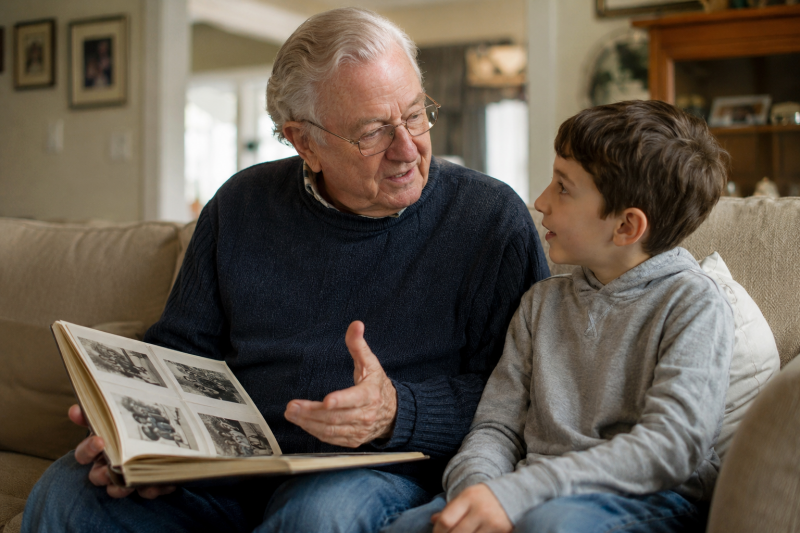
Most kids know their grandparents as Grandma and Grandpa.
They're the people who spoil them a little, tell stories at family gatherings, sneak them an extra cookie, or ask how school is going.
But what many children and grandchildren don't realize is that they're sitting across from a living piece of family history.
Every grandparent has a story that started long before anyone called them Grandma or Grandpa.
They were once kids riding bikes through neighborhoods that may not even exist anymore. They were teenagers figuring out who they wanted to be. They were young adults falling in love, starting careers, serving in the military, raising families, making mistakes, taking chances, and navigating challenges that shaped the people they eventually became.
The problem is that many of those stories never get told.
Not because grandparents don't want to share them.
Usually, nobody ever asks.
That's why one of the most valuable things a child or grandchild can do is sit down and interview their grandparents.
Not for a school assignment.
Not because someone told them they should.
But because there's an entire lifetime of experiences waiting to be discovered.
Family History Is Sitting Right in Front of Us
Most families have stories that get repeated over and over.
Everyone knows the highlights.
Maybe Grandpa served in the military.
Maybe Grandma immigrated from another country.
Maybe someone started a family business.
Maybe there's a story about how two people met and fell in love.
But the details often disappear.
How did Grandpa really feel when he left home for the first time?
What was Grandma's childhood neighborhood like?
What did they dream about when they were fifteen years old?
What scared them?
What made them laugh?
What challenges did they overcome?
Those are the stories that rarely make it into family conversations unless someone takes the time to ask.
Oral history has been used for generations to preserve family stories, traditions, and cultural heritage. Long before people carried cameras in their pockets, families passed history down through conversations.
One person told a story.
The next generation remembered it.
Then they told it again.
That's how family history survived.
Today, we have more technology than ever, but sometimes fewer meaningful conversations.
That's why intentionally sitting down and asking questions can be so powerful.
Grandparents Are More Than Grandparents
This sounds obvious, but many children never really think about it.
To a ten-year-old, Grandpa has always been Grandpa.
To a teenager, Grandma has always been Grandma.
It's easy to forget that before those titles existed, they lived entire lives.
They had first jobs.
First heartbreaks.
Big dreams.
Embarrassing moments.
Adventures.
Failures.
Successes.
The first time a child hears a grandparent talk about being a teenager can be eye-opening.
Suddenly they're not just an older relative.
They're a real person with experiences that feel surprisingly familiar.
Maybe Grandpa got nervous asking someone out.
Maybe Grandma worried about fitting in at school.
Maybe they made decisions they regretted and learned valuable lessons from them.
The distance between generations suddenly feels much smaller.
Discovering Stories Nobody Knew
Some of the best family stories aren't the famous ones.
They're the unexpected ones.
Imagine a child asking their grandfather how he met their grandmother.
The answer might be far more interesting than anyone expected.
Maybe they met at a dance.
Maybe they worked together.
Maybe they met completely by accident because someone missed a bus or took a wrong turn.
The family may know they got married.
But the story of how it all started might be something nobody has heard in years.
The same thing happens with funny stories.
Every family has them.
The trouble is that many disappear because nobody asks.
Sometimes a simple question unlocks memories that haven't been shared in decades.
The result is often laughter, surprise, and a deeper appreciation for the people sitting across the table.
Learning What Life Was Like in Another Era
Children today are growing up in a world filled with smartphones, streaming services, social media, and constant connectivity.
Many grandparents grew up in a completely different reality.
When kids ask questions, they're often amazed by the answers.
What was life like without cell phones?
How did you find your friends?
What did you do for fun?
How did people meet each other?
What was school like?
The answers can sound almost unbelievable.
Some grandparents remember sharing a single family telephone.
Others remember handwritten letters being the primary way to stay in touch.
Some walked long distances to school.
Others grew up in places where television wasn't common.
These stories help children understand how quickly the world changes.
They also help them appreciate that every generation faces different challenges.
Understanding Family Traditions
Many families have traditions they follow every year.
Holiday meals.
Special recipes.
Unique celebrations.
Certain sayings.
Specific customs.
But eventually someone asks a question.
Why do we do that?
And nobody really knows.
Interviewing grandparents is one of the best ways to uncover those answers.
Maybe a holiday recipe came from a great-grandparent who immigrated from another country.
Maybe a family tradition started because money was tight one year and someone got creative.
Maybe a celebration exists because of an event that happened generations ago.
Understanding where traditions come from often makes them more meaningful.
They're no longer just things we do.
They're part of the family's story.
Stories of Hardship and Resilience
Not every conversation needs to focus on happy memories.
Some of the most valuable lessons come from difficult experiences.
Many grandparents lived through hardships that younger generations can barely imagine.
Economic struggles.
Military service.
Immigration.
Loss.
Major historical events.
Periods of uncertainty.
Hearing how they navigated those challenges can provide perspective.
Research has suggested that children who know more about their family history often develop a stronger sense of identity and resilience. Understanding that previous generations faced difficulties and found ways to move forward can help younger family members view their own challenges differently.
A child who learns that their grandparent grew up with very little money may gain a new appreciation for perseverance.
A teenager who hears about obstacles their grandparents overcame may feel more confident facing challenges of their own.
These aren't lectures.
They're real-life examples from people they know and trust.
Preserving Memories Before They Fade
Memory is a remarkable thing.
It's also fragile.
Even the best storytellers can forget details as time passes.
Dates become fuzzy.
Names get harder to recall.
Certain memories fade.
That's simply part of life.
Capturing stories while people are able to share them helps preserve details that might otherwise disappear.
Sometimes it's as simple as sitting at the kitchen table with a notebook.
Sometimes it's recording a conversation on a phone.
Sometimes it's gathering the whole family and asking questions together.
The method doesn't matter nearly as much as having the conversation.
The important thing is making time for it.
Questions Worth Asking
Many kids want to learn more about their grandparents but don't know where to start.
The good news is that most conversations only need one good question.
Here are a few that often lead to incredible stories:
Childhood and Family
-
What was your childhood like?
-
What games did you play growing up?
-
What were your parents like?
-
What did your neighborhood look like?
Life Lessons
-
What is the hardest thing you ever went through?
-
What is the biggest lesson you learned?
-
What advice would you give your younger self?
-
What decision changed your life the most?
Family History
-
How did you meet Grandma or Grandpa?
-
Where did our family come from?
-
What family traditions are important to you?
-
What story should every member of our family know?
Personal Reflection
-
What are you most proud of?
-
What do you hope our family remembers about you?
-
What was your happiest memory?
-
What is a story you've never told me before?
One question often leads to another.
Before long, an hour has passed and everyone is completely absorbed in the conversation.
The Gift of Curiosity
One of the best things about interviewing grandparents is that it doesn't require special equipment, a big budget, or months of planning.
It starts with curiosity.
A child asking a question.
A grandparent sharing an answer.
A conversation that might never have happened otherwise.
Those moments create connections that go beyond everyday family interactions.
They help children see grandparents as complete people with rich, fascinating lives.
They help grandparents feel heard and appreciated.
And they help preserve family stories that deserve to be remembered.
One Conversation Can Last for Generations
Most family treasures aren't things.
They're stories.
They're memories.
They're moments passed from one generation to the next.
The funny stories.
The hard-earned lessons.
The family traditions.
The experiences that explain how a family became what it is today. Every grandparent carries a collection of those stories. The only question is whether someone takes the time to ask.
A simple conversation today could become a story your family tells for decades.
It could answer questions future generations haven't even thought of yet.
And years from now, a child who sat down and asked, "What was your childhood like?" may discover that the greatest family history lesson they ever received came from a conversation at the kitchen table.
Ready to Leave Your Own Voice Behind?
Add comment
Comments