

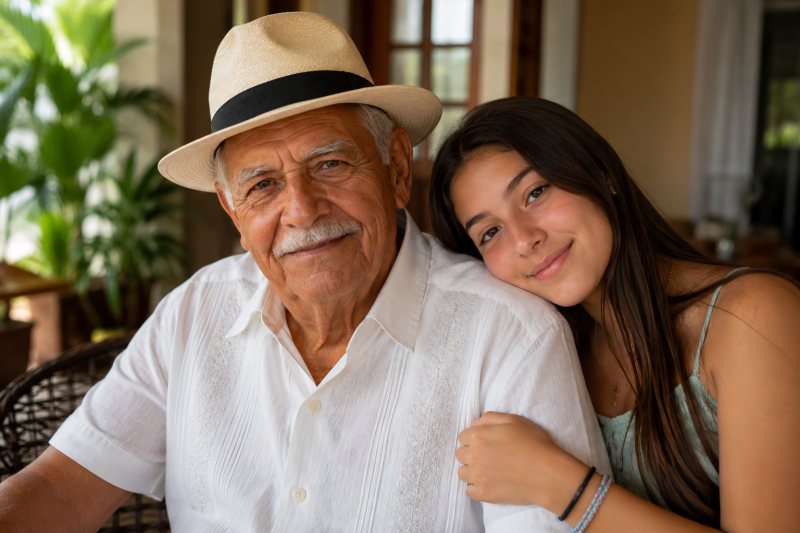
Why preserving a loved one's voice today may become one of the greatest gifts your family ever receives.
There are moments in life that divide everything into two chapters: before and after.
For many families, an Alzheimer's diagnosis is one of those moments.
Life doesn't stop the day a doctor says the words. Birthdays still come. Holidays are still celebrated. Grandchildren still grow up. On the surface, everything looks familiar. Yet underneath it all, everyone knows something has changed. The future suddenly feels uncertain, and ordinary moments begin carrying a weight they never had before.
At first, the signs can be so subtle that they're easy to explain away. A forgotten appointment. A story told twice during the same dinner. Searching for a word that once came effortlessly. Families often laugh it off because nobody wants to believe it's the beginning of something bigger.
Eventually, though, those small moments become harder to ignore.
The person who never forgot a birthday suddenly struggles to remember the month. The grandfather who could fix anything around the house forgets how to use a tool he's held his entire life. A grandmother who spent decades cooking family recipes begins asking for help making meals she could once prepare without looking at a cookbook.
Then comes the day many families never forget.
A look of uncertainty crosses their face as they try to remember someone they've loved for decades.
It's impossible to describe that feeling unless you've lived it.
The person is still sitting in front of you. Their smile may still be there. Their laugh may still sound familiar. But pieces of the life you've shared together begin slipping away, one memory at a time.
One thing, however, doesn't have to disappear with those memories.
Their voice.
Most of us don't realize how much a voice matters until we can no longer hear it.
We spend our lives taking pictures because they're easy. Every birthday, every vacation, every holiday gathering ends with dozens of photos stored on our phones. Years later we scroll through them and smile because they remind us of where we were.
But photographs are silent.
They can't capture the way Grandpa laughed before telling one of his stories. They don't preserve the way Grandma always called you by a nickname that nobody else ever used. They can't replay the warmth in someone's voice when they told you they were proud of you.
Those things live in sound.
That's why people hold onto old voicemail messages for years.
If you've ever found yourself listening to a voicemail from someone you've lost, you already understand this. Chances are the message wasn't remarkable. Maybe they were calling to remind you to pick up milk or asking you to call them back when you had a chance.
The words weren't what mattered.
The voice was.
Hearing someone exactly as you remember them has a way of collapsing time. For a few seconds, they're not just a memory. They feel present again.
That's something Alzheimer's can never take away once it's been preserved.
One of the most meaningful stories I've seen through StillHear didn't begin with a diagnosis or a goodbye.
It began with a simple decision.
A customer spent an afternoon with her boyfriend's grandmother. They talked, laughed, shared stories, and recorded her voice while she was still able to speak clearly and comfortably.
Nothing tragic had happened.
Nobody was saying farewell.
She simply understood something many of us don't realize until it's too late.
Today won't always look like today.
Instead of assuming there would always be another opportunity, she decided to create one herself.
After recording her boyfriend's grandmother, she scheduled that recording to be delivered as a future phone call through StillHear.
I remember thinking how beautiful that choice was because she wasn't preserving the past.
She was creating part of the future.
Years from now, her boyfriend's phone will ring. On the other end will be a voice that may no longer sound the same or, depending on what life brings, may no longer be here at all.
That phone call won't erase grief.
It won't cure Alzheimer's.
What it will do is give someone a moment they otherwise never would have had.
That's an incredible gift.
Most of our favorite memories happen by accident.
This one was created intentionally.
That's the heart of what StillHear is about.
People often assume the service exists because of death. While it certainly helps families preserve voices before it's too late, I see it differently.
It's about giving ourselves the chance to create moments that don't exist yet.
A phone call on a wedding morning.
A message on a grandchild's eighteenth birthday.
Words of encouragement before someone's first day of college.
An anniversary.
A retirement.
Or maybe no special occasion at all. Maybe it's just an ordinary Tuesday years from now when someone could use the comfort of hearing a familiar voice.
Those are future memories.
The remarkable thing about Alzheimer's is that it changes how we think about time.
Before a diagnosis, we assume there will always be another Christmas, another family barbecue, another chance to ask Grandpa about growing up or hear Grandma tell the story about how she met the love of her life.
After a diagnosis, those opportunities suddenly feel precious.
The conversations become more important.
The laughter becomes more noticeable.
Even the quiet moments sitting together in the same room begin to feel different.
Many families wish they had recorded more than just birthdays and holidays.
They wish they had captured an ordinary afternoon at the kitchen table.
A conversation on the porch.
A favorite joke.
A story that had been told a hundred times.
Those everyday moments often become the ones we miss the most because they were never meant to be extraordinary. They were simply life unfolding in real time.
If someone you love is living with Alzheimer's or is beginning to show signs of memory loss, don't wait for the perfect moment to record them.
There isn't one.
Don't worry about finding expensive microphones or writing the perfect script. In fact, the less scripted it feels, the better.
Ask them what life was like when they were young.
Ask how they met their husband or wife.
Ask about their first job.
Ask what they were most proud of.
Ask what advice they hope their grandchildren will carry with them.
Let them wander into old stories. Let them laugh halfway through a sentence. Let them pause to remember a detail before continuing.
Years from now, those little moments may become priceless.
Even if Alzheimer's is never part of your family's story, preserving someone's voice is still one of the most meaningful things you can do.
None of us knows what tomorrow holds.
Life changes quietly sometimes.
A diagnosis.
An accident.
A move across the country.
A phone call that changes everything.
We spend so much of our lives preparing financially for the future. We save for retirement, buy insurance, and write wills because we understand that planning matters.
Very few of us think about preserving the sound of the people we love.
Maybe we should.
One day your children may not care what kind of car you drove or how big your house was.
They may not remember every birthday present you ever gave them.
But hearing your voice tell them, "I love you. I'm proud of you. Everything is going to be okay," is something they'll never forget.
That isn't just a recording.
It's reassurance.
It's comfort.
It's presence.
It's love arriving exactly when someone needs it most.
That's why I believe voices deserve to be preserved with the same care we give our photographs and family heirlooms.
Because unlike almost everything else we leave behind, a voice has the power to make someone stop whatever they're doing, close their eyes, smile, and feel like they're with the person they miss, even if it's only for a few minutes.
The woman who recorded her boyfriend's grandmother understood that.
She didn't wait for the perfect time.
She didn't assume tomorrow would look exactly like today.
She chose to intentionally create a future memory.
Maybe that's the greatest gift any of us can leave behind.
Not because we're preparing for the end, but because we're choosing to make sure our love can still be heard, no matter what the future brings.
Add comment
Comments