

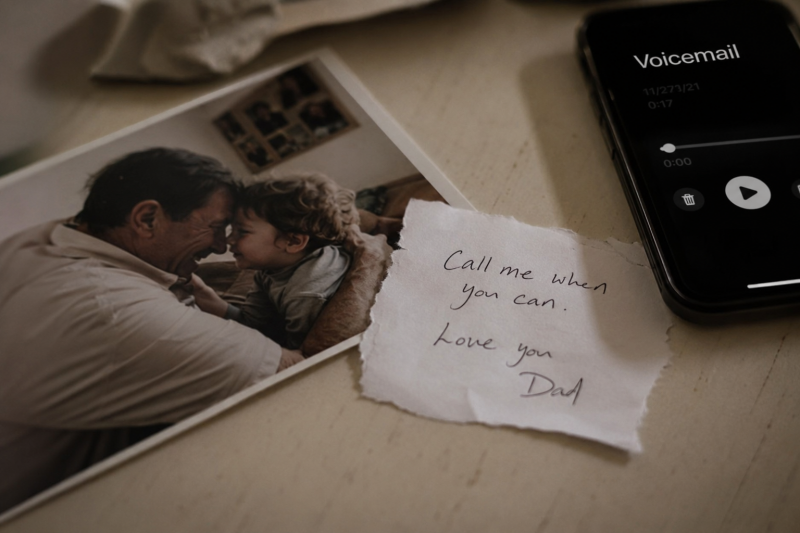
If you've lost someone you love, you already know there isn't a magic sentence that suddenly makes everything okay. People say what they can because they care, but even the kindest words eventually fall short. Grief doesn't work like a broken appliance you can repair or a problem you can solve. It simply becomes part of your life, changing shape over time but never completely disappearing.
Most people don't wake up one morning and decide they're "over it." Instead, they learn how to carry it. Some days it's surprisingly light. Other days it feels just as heavy as it did years before. That's one of the things people rarely talk about until they've lived through it themselves.
One of the hardest parts about grief is realizing that the rest of the world keeps moving. Birthdays still come around. Christmas arrives whether you're ready for it or not. Kids graduate, weddings happen, grandkids are born, and life keeps placing you in moments where the first person you want to call is the one person who can't answer. You don't forget they're gone. It's just that, for a split second, your heart reaches for them before your mind catches up.
Those moments can catch you completely off guard. You might be standing in the grocery store, hear a song they used to sing, or smell someone's cologne that reminds you of your father. Suddenly you're somewhere else entirely. Not because you're dwelling on the past, but because love has a way of attaching itself to ordinary moments.
It's strange how something so ordinary can stop you in your tracks. A recipe written in their handwriting. A baseball game they would have loved. Driving past their old house. Seeing a car that looks just like the one they drove. None of these moments ask for permission. They simply arrive, reminding you that grief isn't something you schedule. It has a way of finding you.
People who haven't experienced deep loss sometimes assume that grief fades in a straight line. That each year gets a little easier than the last. Anyone who has actually buried someone they loved knows that's rarely how it works.
Sometimes five years later hurts more than year one.
Not because you loved them more, but because life has continued without them. There have been birthdays they never celebrated. Family photos they aren't in. Stories they'll never hear. New traditions they never got to be part of.
The distance between today and the last time you heard their voice quietly grows.
That's another part of grief people don't often talk about.
You don't just miss the person.
You begin missing the sound of them.
At first, their voice feels impossible to forget. You can replay it perfectly in your mind. You remember the way your mom laughed before she couldn't finish a sentence because she was laughing too hard. You remember how your dad always answered the phone. You remember the nickname your grandmother called you that nobody else ever used.
Then life keeps moving.
Months become years.
One day you catch yourself wondering...
"Am I remembering their voice correctly?"
That question alone can break your heart.
Photographs freeze a moment in time. They remind us what someone looked like. But voices are different. A voice carries personality. Emotion. Humor. Comfort. It's where so much of a person's identity lives.
Think about it.
Without even seeing someone's face, you can instantly recognize the voice of someone you love. That's how deeply our brains connect voices with safety, belonging, and memory.
It's why people save old voicemails for years.
It's why a twenty-second recording can become one of the most treasured things a family owns.
It's why losing those recordings can feel like losing a piece of the person all over again.
The truth is, most of us never think to preserve our voices intentionally.
We assume there will always be another birthday.
Another Christmas.
Another phone call.
Another chance to say the things we've been meaning to say.
Life has a way of convincing us that tomorrow is guaranteed.
Until it isn't.
I've learned that firsthand.
Years ago, I was perfectly healthy. Then, without warning, I suffered an unprovoked pulmonary embolism. One moment I was living life like everyone else. The next, I was fighting for it. It changed the way I look at time.
Later, when my wife was diagnosed with cancer, that lesson became even more personal. Suddenly, the future stopped feeling like something that was promised and started feeling like something we hope for.
Those experiences didn't make me afraid of death.
They made me appreciate today.
Because none of us knows which ordinary conversation will someday become the last one someone remembers.
That's ultimately why StillHear exists.
Not because it can solve grief.
It can't.
It was never designed to.
StillHear can't remove the empty chair at Thanksgiving.
It can't stop someone from crying on Father's Day.
It can't erase the ache of wishing one more conversation were possible.
If anyone ever tells you a product can fix grief, they're selling you something impossible.
What StillHear was built to do is much simpler.
It helps create one more moment of connection.
Imagine it's your daughter's wedding day years from now.
She knows you aren't walking through those doors.
Nothing changes that.
But then her phone rings.
She hears your voice telling her how proud you are. Telling her to dance. Telling her you love her. Telling her she's going to be okay.
Does that erase grief?
Of course not.
But it changes that moment forever.
Or imagine a son who's having the worst year of his life. His birthday arrives, and instead of another reminder of who's missing, he hears his father's voice wishing him a happy birthday.
He still wishes his dad were there.
That never changes.
But for a few minutes, the silence is replaced with something real.
Not AI.
Not someone reading a letter.
His father's actual voice.
Sometimes people ask whether hearing that recording would make grief harder.
I actually think it reminds us of something important.
Love doesn't end because a life does.
The people we lose continue shaping us through the memories they've left behind, the lessons they taught us, and the words we still carry with us. Hearing their voice doesn't reopen love.
Love was never closed.
It simply reminds us that relationships don't disappear the moment someone dies. They continue in different ways.
The problem is that most families don't realize what they'll miss until it's already gone.
They save thousands of photos.
Videos of vacations.
Pictures of birthday cakes.
Screenshots of funny text messages.
Yet somehow, they never intentionally preserve the one thing that instantly makes someone feel present again.
Their voice.
Not because they didn't care.
Because they assumed there would always be another chance.
That's the quiet tragedy.
Regret usually doesn't come from the things we intentionally ignored.
It comes from the things we never imagined we'd lose.
No one sits down and says, "I'm going to forget what my mom sounds like."
No one thinks, "I should probably record Dad because next year he might not be here."
Life doesn't work that way.
It simply keeps moving until one day you realize the opportunity has passed.
That's why this isn't really a conversation about grief.
It's a conversation about today.
If everyone you love is still here, that's something to be grateful for.
It also means you have something many grieving families wish they could have back for just five minutes.
Time.
Not endless time.
Just enough time to ask the questions you've never asked.
To record the stories you've never heard.
To save the laugh you've always taken for granted.
To tell someone what they've meant to your life.
Grief will eventually visit every family.
None of us gets to choose whether it arrives.
The only choice we really have is what we'll wish we had done before it did.
Years from now, you probably won't regret spending a few minutes preserving someone's voice.
But you may regret believing you always had more time.
Don't Wait Until Their Voice Is All You Have Left
Add comment
Comments