

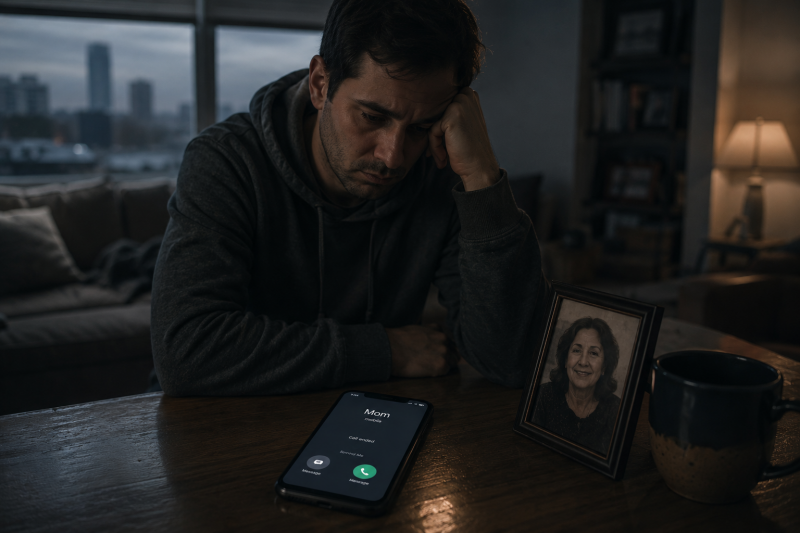
I came across something recently that got me thinking about a part of grief we really don't talk about much. When someone dies, you obviously miss the person. You miss their face, their voice, their personality and all the things you used to do together. But there are also these little routines that disappear with them, and sometimes you don't realize how much those routines meant until they're gone.
Maybe you called your mom on the way home from work every day. Maybe you talked to your dad every Sunday morning. Sometimes you called because you needed advice, and other times you didn't have anything important to say at all. You just called because that's what you did. It became such a normal part of your life that you never stopped to think there would eventually be a day when you couldn't do it anymore.
Then that day comes.
It's Not Always the Big Moments
We usually talk about grief around birthdays, holidays, anniversaries and other important dates. Those days can obviously be difficult, but sometimes it's a completely normal Tuesday that catches you off guard. You pick up your phone without thinking about it, and for a second you almost make that call you've made a thousand times before. Then you remember.
I think that's one of the strange things about losing a parent as an adult. You can be 40, 50 or 60 years old. You can have your own family, career, mortgage and a whole list of people depending on you. You're completely capable of taking care of yourself, but that was still your mother or your father. There was still somebody in this world you could call and, for a few minutes, just be their kid again.
When that person is gone, there's an emptiness left behind that can be difficult to explain. You're not only grieving the person. You're also adjusting to all the little places they occupied in your everyday life.
We Save Voices for a Reason
I've thought about voices a lot since starting StillHear, especially because the whole idea began with something I witnessed in my own family. During my wife's cancer treatment, she would listen to old voicemails from her mother, who had already passed away. I saw what those recordings meant to her, and it completely changed the way I looked at an ordinary voicemail.
They weren't professionally recorded messages. Her mother didn't sit down and carefully create something she thought would become a family keepsake. They were simply voicemails she had left while she was alive, but now they contained something that couldn't be replaced: her actual voice.
There are probably millions of people with recordings like that sitting on their phones right now. They may have transferred them from one phone to another or backed them up somewhere because they can't bring themselves to delete them. A photograph can bring back a memory, but hearing someone's voice can bring back things a photograph can't. You hear the accent, the laugh, the pauses, the way they pronounced your name and all those little imperfections you never thought twice about when the person was still here.
There's Something Different About a Phone Call
As valuable as an old voicemail can be, you still have to go looking for it. You find the recording, press play and wait for the voice you already know you're about to hear.
A phone call has always worked differently. Think about somebody you talk to regularly and what happens when their name appears on your screen. Before you even answer, you already know who's waiting on the other end. There's a familiarity to the whole thing that we barely notice because we've experienced it so many times.
The ringing itself becomes part of that routine. So does seeing Mom or Dad on the screen, answering the phone and hearing that first "hello." These are incredibly small details, but after years of talking to someone, they're woven into the relationship.
That's something I've thought about more as StillHear has grown. Delivering someone's voice as an actual phone call isn't exactly the same experience as opening an audio file and pressing play. The recording might contain the same voice, but the way that voice reaches you changes the moment.
What If We Planned for Those Moments?
People sometimes hear the idea behind StillHear and immediately associate it with death. I understand why, but I don't think that's what this has to be about. You don't need to be sick or expecting something bad to happen to record something for the future. I'd actually rather people do it while they're healthy, living their normal lives and sounding exactly like themselves.
You could record something for your daughter's wedding even though she's only 15 today. You could leave your son a message for his 30th birthday, record something for a grandchild to receive years from now, or even schedule a call to yourself five years from today and talk about where you hope your life will be by then.
The message doesn't have to sound like something written for a movie either. Talk the way you normally talk. Tell the same bad joke you've told a hundred times. Use the nickname nobody else uses. Tell them you're proud of them. Tell them you love them. You could even spend three minutes talking about absolutely nothing important, because the things that seem ordinary today may be exactly what someone misses someday.
Your Voice Probably Matters More Than You Realize
Most of us don't think our own voice is anything special because we hear ourselves every day. The people who love us don't experience it that way. To your children, your voice has been part of their world for as long as they can remember. To your spouse, it may be one of the most familiar sounds in their life.
The same is true when we think about our parents. If you're lucky enough to still have them, think about how many times you've seen Mom or Dad appear on your phone. Think about how many conversations you've had that seemed completely unimportant at the time. Maybe you talked about work, complained about traffic, asked what they were having for dinner or called because you needed help remembering how they used to make something.
Those ordinary conversations don't feel valuable while they're happening because we assume there will always be another one.
That's really what sticks with me. We put so much effort into preserving life's big moments that we sometimes overlook the everyday things that make up most of our relationships. Years later, those ordinary moments may be the things we would give anything to experience one more time.
That's why I believe we should save the voices of the people we love while we still can, and maybe we should think about leaving some of our own voice for the people who love us too. Not because we're expecting something bad to happen, but because none of us knows what the future looks like.
Someday, someone may miss the simple experience of seeing your name on their phone more than you could ever imagine today.
Your Voice Means More Than You Think
StillHear allows you to record your real voice today and schedule it to arrive as a real phone call in the future. It could be for a birthday, wedding, anniversary, milestone or simply a day that means something to you.
No recreated voices and no AI pretending to be someone it isn't. Just your real voice, recorded by you, waiting for the moment you chose.
Add comment
Comments